
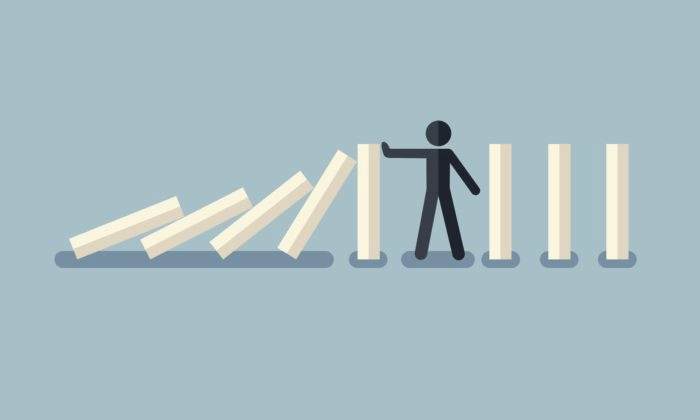
“I can be changed by what happens to me. But I refuse to be reduced by it.”
Maya Angelou
Life is not always a bed of roses for all of us. It mostly throws unexpected bouncers at us. Some of us just throw our wicket and lament as if we have lost the complete match while some others just try to stick onto the crease and score high although they are not able to hit boundaries or sixes. This quality of calmly navigating our life through the adversities is termed as resilience. So, whenever we face a challenging situation in our life, we have a choice either to get stuck and feel defeated or to accept the situation and fight by with the available resources. If we have a resilient mindset, we tend to opt for the latter and keep going until we find the way out.
It is true that some people are born with this resilient mindset but the ones who lack it, can definitely try and work on developing resilience. It’s a myth that the individuals with high resilience do not experience emotions like fear, anxiety, grief, etc when they encounter the adversities. Rather, they have great coping skills to deal with these emotions and focus on the challenge they have to face.
I am always amazed by the resilience showed by the people residing in low lying areas. Every time, it rains heavily, the water fills up in these areas, they have to gather their belongings, vacate their houses and shift to the temporary places made available to them. And when the water level subsides, they again pack up everything and return to their houses which have been damaged due to the floods. They start their lives afresh. It’s not that they don’t feel devastated but then instead, they focus on fighting the situation and getting back to normal as early as possible. In their case, may be the situation is the key factor in developing their resilience, but we should intentionally try to build resilience in us to lead an effective life. Let’s find out how.
- Come out of your comfort zones: Comfort zones are our safe places where we tend to feel relaxed and secure. But the more we stick to our comfort zones, the more we are likely to get terrified even in slightly challenging situation. So, when we put ourselves deliberately in new and unknown situations, we will be able to find out the triggers which stress us out and also slowly start looking out for solutions of dealing with such situations. So, when next time we face any challenging situation, we are better equipped to deal with it, thus increasing our resilience.
- Change your mindset: Well, we mostly have a limited idea of our abilities and therefore, we tend to develop a fixed and negativistic mindset. This mindset is nothing but our beliefs about ourselves and others. So, if I have a fixed mindset, I’ll think that some things are just impossible for me even if I try hard. This mindset then stops me from either getting into that particular scenario or accepting complete defeat if faced that situation. If we want to build resilience, we need to come out of this mindset and adapt a rather positive mindset that although the situation is difficult we can still cope and find way out of it.
- Learn to accept changes: Being flexible is the most important aspect of resilience. The more quickly you adapt to the changes occurring in your life, the easier it is for you to deal with them rather than just being stuck. There is a very thin line between being organised and being rigid. Preferring to do certain things in a particular way which either improves the quality of work or simplifies it may be considered as being organised but behaving as if the way I do things is the only way to do work and denying changing it accounts to rigidity. Rigid thinking can lead to emotional outbursts, depression and unhappy life. So, the key to become more resilient is to embrace a flexible approach in daily life. Thinking and doing things differently can be a step in this journey which will help in accepting the changes smoothly.
As we have seen, resilience is an essential quality to bounce back from many distressing situations we face in our daily lives. Building resilience is very helpful to be emotionally stable even during the hardships, so let’s try to equip ourselves with resilience using the techniques that suit us the most.
Those who are already resilient can work further on this attribute by learning some self-improvement techniques and problem-solving skills. Of course, resilience is not a magic pill which can bail us out of any problem, but it can surely act as a tonic for us. I would love to conclude by quoting this phrase by Carl Jung:
“I’m not what happened to me, I’m what I choose to become!!”

 Mind Matters!!