We can learn to control our thoughts, emotions and behaviors so they no longer control us!!
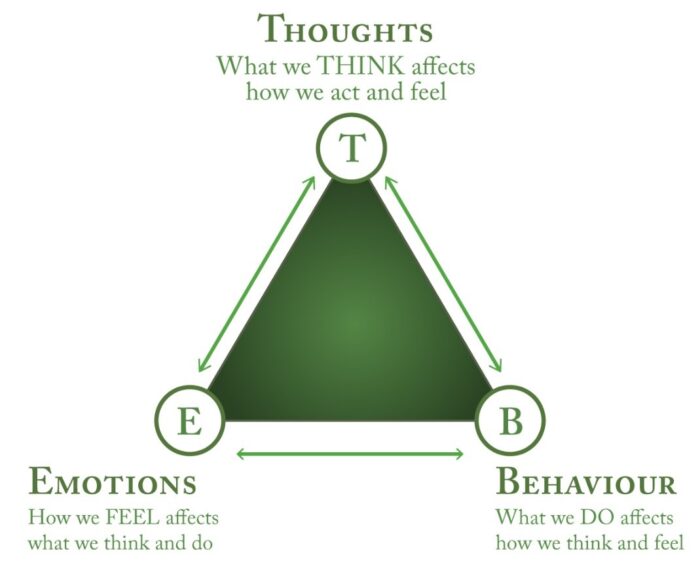
We face many different situations in our lives, and we respond to these situations in different ways. We keep on thinking that our response is a result of these situations. But psychology tells us otherwise. It says that there is never just a direct equation like event/situation —-> Response, rather there is always a role of our thoughts, emotions and behavior in this.
When an event happens, a cycle of many thoughts starts in our mind. Some emotions also arise from these thoughts and under the influence of both of them, we develop certain types of behavior. Sometimes, in accordance with the event the emotion is created first and then thoughts and behaviors occur, while sometimes after the event occurs, we act in a particular way immediately and then thoughts and feelings come into the picture. Let’s take an example to understand how these three factors work.
For this, we will consider 4 individuals (A, B, C, and D). Let’s say their boss is angry at all of them for missing an important deadline. Now, if an event is the only criterion for the response, then all four of them should have the same response to this incident. But in reality, it is difficult to get a single and similar response to any event. That is, maybe person A will get angry (Self-talk: “What does this man think of himself!! I am doing so many things at a time, what if I miss a single deadline. Just because he is a boss, he can’t talk to me like that.” Emotion: Anger, Behavior: Being infuriated with others at home or office, completing the task in anger affecting its quality.) Person B will be depressed (Self-talk: “What is the use of doing so much work here, no one is happy! All my efforts always go in vain. I’m unable to keep up to anyone’s expectations. I could not even finish such a simple task on time!” Emotion: Depression, Behavior: Keep blaming himself or fate, working with a depressed mind.) Now, person C may be scared (Self-talk: Oh God.. the boss is angry with me again; what to do now?? If I continue to make the same mistakes, he is going to blacklist me! My overall performance will definitely be affected, there will be no salary hike or what if I lose my job..!!.”, Emotions: Fear, Behavior: Losing confidence due to fear, making mistakes in work). Person D will take appropriate action by keeping the boss’s words in the form of feedback about the work rather than considering it an evaluation (Self-talk: Agree that I have missed the deadline, but the boss was too harsh with his words. I certainly did not like his behavior. But maybe, he is also under pressure and answerable to his superiors that’s why he lost his cool. I will try to get the job done as soon as possible so that there is no further delay. Emotion: Disappointment, Behavior: Understanding the situation properly in spite of the disappointment and getting the job done.)
This example shows that even when the event is same in case of all the four individuals, their thoughts about the event made a considerable difference in their emotions and behavior. We can see that the intensity of the emotions experienced by individuals A, B and C is higher whereas although individual D is not very happy with the event, he still could show a balanced behavior as the intensity of his emotions was on the lower side. Hence, if we practice evaluating our thoughts in every situation, then we can learn to strike a balance between our emotions and behavior. This also means, we can remain functional in any difficult situation by learning to reduce the intensity of our distressing emotions. Let’s befriend this triad of thoughts, emotions and behavior then!!
Thoughts become Things, Choose the good ones!!

 Mind Matters!!